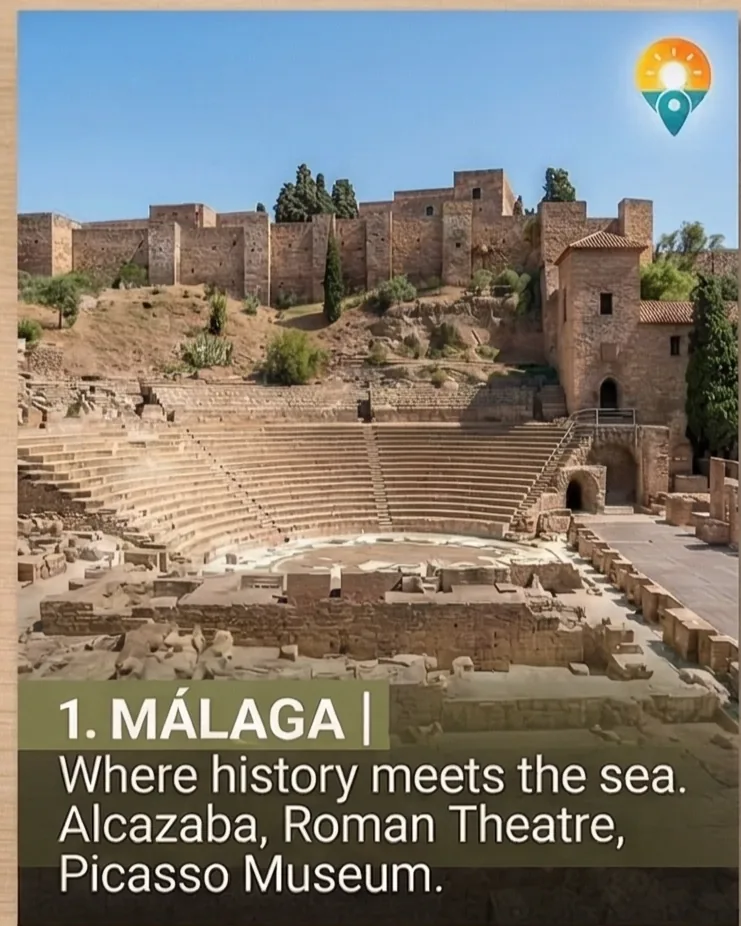
Málaga has quietly transformed itself from a mere gateway city — the airport most people arrive at before heading west to the resort towns — into one of Spain's most exciting urban destinations. The city that gave the world Pablo Picasso now rivals Seville and Granada for cultural richness, beats both for food, and adds something neither can offer: a city beach five minutes' walk from the Cathedral.
The historic centre is compact and walkable. The tapas scene is outstanding. The Alcazaba fortress looks over the whole city from a hill that takes 15 minutes to climb. And after two or three days exploring, you can be in Nerja, Ronda, or any of a dozen beach towns within an hour. Málaga works brilliantly as both a destination in itself and a base for the wider Costa del Sol.
Top Things to Do in Málaga
1. Alcazaba & Castillo de Gibralfaro
The Alcazaba is Málaga's most impressive monument — an 11th-century Moorish palace-fortress built by the Hammudid dynasty on the ruins of a Phoenician and Roman settlement. The complex rises in a series of walled terraces above the city, each gateway more ornate than the last, with fountains, gardens, horseshoe arches and tilework throughout. The views over the port and coast from the upper terraces are exceptional.
Continue uphill (20 more minutes on foot, or via the lift from the Alcazaba entrance) to reach Castillo de Gibralfaro, the 14th-century hilltop fortress that crowns the mountain above the city. The walkway around the battlements gives a 360° panorama: city, port, coast, mountains. Go late afternoon for the best light — and stop at the small parador café on the way down for a cold drink.
- Alcazaba: Open Tue–Sun, 9am–8pm (summer) / 9am–6pm (winter). Adults €3.50, under 18 free
- Combined ticket (Alcazaba + Gibralfaro): €5.50. Free Sunday afternoon from 2pm
- Tip: Visit Alcazaba first (lower, in the shade), then walk up to Gibralfaro — not the reverse
2. Picasso Museum Málaga
Pablo Ruiz Picasso was born in Málaga in 1881 at Plaza de la Merced 15 (his birthplace house is now a museum and open to visit). The Museu Picasso Málaga, opened in 2003 and housed in the magnificent 16th-century Buenavista Palace, holds 233 works donated by his daughter-in-law Christine Picasso and grandson Bernard — a permanent collection spanning every period of his career from early academic paintings to Cubist masterpieces.
It's one of the most important Picasso collections in the world, and — crucially — far less overwhelmed by crowds than the Picasso Museum in Barcelona or the Musée Picasso in Paris. You can actually stand in front of major works without fighting through tour groups.
3. Málaga's Museums — The Full Picture
Málaga has more museums per capita than any other city in Spain — 37 at last count. You obviously can't see them all, but a few deserve singling out:
Centre Pompidou Málaga
Satellite of the Paris original inside the "Cubo" glass cube at the port. Rotating exhibitions of 20th–21st century art: Frida Kahlo, Francis Bacon, Cindy Sherman. Outstanding.
€9 · Closed Tue
Carmen Thyssen Museum
Spanish and Andalusian 19th-century painting — bullfighting, flamenco, coastal scenes. Housed in a beautiful Renaissance palace. Underrated and usually quiet.
€10 · Free Sun from 5pm
Málaga Cathedral
16th–18th century, known as "La Manquita" (the one-armed one) because the south tower was never finished. Climb the roof for views. The interior is magnificent.
€6 · Open Mon–Sat
Roman Theatre
1st-century BC theatre discovered during construction in 1951, now excavated and open to visit for free. Right next to the Alcazaba entrance — absurdly good value.
Free · Open Tue–Sun
Explore Málaga with an AI Guide
SolGuide narrates Málaga's history as you walk — Alcazaba, Roman Theatre, Picasso's birthplace, Cathedral — triggered by GPS. Plus restaurant picks and skip-the-queue tips.
Get SolGuide Free →iOS & Android · First month free · No credit card
4. Soho Arts District
Málaga's Soho — the grid of streets immediately south of the historic centre between Alameda Principal and the port — has become one of the best street art districts in Europe. The MAUS project (Málaga Arte Urbano Soho) commissioned murals from major international artists including Shepard Fairey, D*Face and Okuda San Miguel. A self-guided walk takes 45–60 minutes and is completely free.
The district also has a strong independent restaurant and café scene — less touristy than the historic centre and noticeably cheaper. Calle Trinidad and Calle Tomás Heredia are the main arteries.
5. Atarazanas Market
Málaga's covered market occupies a 14th-century Nasrid shipyard — you can still see the original Moorish horseshoe arch entrance. Inside: stalls of fresh fish, jamón, olives, fruit and vegetables, plus several bars doing excellent breakfast and morning tapas. Go between 9am and 1pm (it closes at 2pm). One of the finest market experiences in southern Spain.
6. Beaches in Málaga
The city beaches are surprisingly good given how urban the surroundings are. Playa de la Malagueta, the main city beach, is a 10-minute walk east from the Cathedral — 1.2km of dark sand with beach bars, sun loungers and views back to the city skyline. It fills up quickly on summer weekends, but on a Tuesday morning in June it's genuinely lovely.
For longer, less urban beaches, Playa de la Misericordia and Playa de Pedregalejo (5km west by bus or metro) have rows of excellent chiringuitos (beach restaurants) and a neighbourhood feel far removed from the tourist centre. The fish and espetos (sardines grilled on cane poles over beach fires) at Pedregalejo are some of the best on the coast.
Concerts & Events in Málaga
Málaga has a busy calendar of live concerts and events throughout the year — open-air summer concert seasons, Ticketmaster shows, and one-off festivals across the Costa del Sol. If a night out to live music is part of your trip, it's worth checking what's on before you book your dates.
See upcoming concerts and events in Málaga →
Málaga Food Scene
The local tapas tradition in Málaga is one of the last places in Andalucía where many bars still serve a free tapa with every drink ordered. The tapas culture here is genuinely participatory — not a tourist performance.
Best Areas for Tapas
The streets around Plaza de la Merced and Calle Granada in the historic centre have the highest density of good tapas bars. The neighbourhood of El Palo (8km east) is where Malagueños eat on weekends — raw, local, excellent espetos on the beach.
What to Eat in Málaga
Espetos de sardinas — sardines grilled on cane skewers over wood fire on the beach. A Málaga institution, best at Pedregalejo.
Porra antequerana — thick cold tomato soup (thicker than gazpacho) with tuna and egg. Local speciality, summer staple.
Boquerones en vinagre — white anchovies marinated in vinegar. Every decent bar serves them. Order with cold beer.
Vino dulce — Málaga's sweet wine, made from Pedro Ximénez and Muscat grapes. Try it as an aperitivo or with dessert.
Day Trips from Málaga
Málaga's position makes it an ideal base for exploring the wider region. The train station connects to several key destinations:
- Ronda — 2 hours by direct train (€15–20). One of the most dramatic hilltop towns in Spain — the Puente Nuevo bridge over a 100-metre gorge is extraordinary. Allow a full day.
- Nerja — 1 hour by bus. Crystal beaches, the Balcón de Europa clifftop promenade, and prehistoric caves. See the Nerja guide for full details.
- Granada — 1.5 hours by bus or 1 hour 40 minutes by train. The Alhambra palace requires booking weeks in advance in summer — plan accordingly.
- Seville — 2 hours by high-speed AVE train (€25–35). An easy and very worthwhile day trip or overnight.
Getting Around Málaga
The historic centre is entirely walkable — most key sights are within 20 minutes on foot of each other. For the beaches and outer neighbourhoods:
- Metro: One line connecting the airport with the city centre and western beaches (El Palo direction is served by bus). Ticket €1.35, airport to centre.
- Bus: Extensive EMT network covering all areas. Day passes available. Most useful for beach routes (lines 11, 3, 11C to Pedregalejo).
- Cycling: Málaga has a growing network of cycle lanes. Shared bike hire (Mybici) stations across the city.
- On foot: The best way. Calle Marqués de Larios, the main pedestrian boulevard, leads directly from the Cathedral to the port — everything of note is within a 10-minute walk.